
The Present and Future of Austin Housing Market
A data-driven analysis of housing demand, consumer behavior, and pricing dynamics using real-world market data
Background
The US housing market has been experiencing a rapid increase in price. The value of houses across the nation has increased by 13.44% between May 2020 and May 2021. This number is 3 times higher than the corresponding period in 20191. The situation in the Greater Austin Area is much worse. The average value of houses in the area was $351,000 in May 2019. However, in May 2021, the number was $458,000, which is 1.3 times higher than one year ago, and Zillow expects the number will increase to $629,000, which is 1.8 times higher than the one in May 20192. Since the Subprime Mortgage Crisis in 2007, this is the first time for both the US and the Greater Austin Area to experience this unexpected and unprecedented increase in housing prices. This paper aims to identify the factors that caused this unpredictable price increase and predict the market movements in the future.
Analytical Method and Data Sources
Market Pricing Model
A market pricing model is primarily used because there are many suppliers and buyers in the housing market3. Although the City of Austin has tried hard to supply affordable housing options to settle down the market, this paper only focuses on market-rate houses and does not cover the effect of subsidies from the city.
Price Elasticity Analysis
Price elasticity is the change of demand or supply in response to the change of price4. This paper focuses on how the combinations of the factors have affected the market, and how supply and demand will react in response to the price change to predict the possible future market movement.
Data Sources
The Greater Austin Area or the Austin Area means Austin-Round Rock Metropolitan Area. The most real estate market data used in this paper is primarily from Texas Real Estate Research Center, Texas A&M University, and Zillow. The demographic data is primarily from the U.S. Census Bureau. More detailed sources of data can be found in the bibliography at the end of the paper.
Analysis and Result
Demand Analysis
Demographic factors.
The Austin Area has experienced a large amount of population growth. In 2020, a net migration in the area was 53,266, which was 25% higher than the previous year and the fifth-largest number among other metropolitan areas in the US. The area’s net immigration to population ratio was 2.32%, which was higher than the US average, 0.14%, and the other top 10 areas’ average, 1.2%5. This population increase has made a rightward shift in the housing market demand curve.
In 2019, the median age of the Austin Area was 33.3 years old that is 2 years higher than the one in 2011, 30.9 years6. According to Zillow, the typical first-time homebuyer in the US is 34 years old7. Moreover, people who are 34 years old right now are in the millennial generation, the largest generation in the US, which takes 25% of the US population8. This means that there have been and there will be more people who want to buy houses in the Austin Area, which can move the demand curve to the right.
COVID-19
Due to COVID-19, many people have worked from home, and people who have higher income switched more to telework during the pandemic. Although the pandemic seems to be over soon, they prefer to work from home after the situation is over9. Austin’s median household income was $76,925 in 2018, which is higher than the US median household income, $61,93710. Therefore, people in the Austin Area more tend to prefer working from home, and it causes higher demand in the market.
An Influx of Tech Giants
Recently, tech giants have tried to move their HQs or offices to the Austin Area. Some companies like Apple, Tesla11, Samsung12, Oracle13 have already announced their moving and the future potential hires from those companies are expected to be more than 30,000 in the next few years. Moreover, those companies normally give their employees higher salaries than the national average. The new hire seems to attract not only people who have already lived in the area but also people outside the area that can make more demand in the housing market.
US Fed Funds Rate and Personal Saving Rate
The effective Federal Funds Rate has been almost zero since the pandemic happened in May 202014. Also, the personal saving rate in the US in February 2021 was 13.6%, which is relatively higher than the one in the pre-pandemic era, 7.5%15. Therefore, people can get mortgages with lower interests and have enough cash for the down payment, which has created more demands in the market.
Supply Analysis
Existing Housing
The Austin Area has experienced a housing shortage since November 2020. The month of inventory has been below 1 month since then16. In April 2021, the number of active listings was 1,901, which is 70% lower than one year ago. Also, months of inventory was 0.5 months, which is 1.5 months lower than the same period in the previous year17. Currently, available housing options are not enough to ease the housing situation, which moves the supply curve to the left side.
New Construction
New construction by professional development companies takes about 7.7 months including building authorization, permits, and actual construction. In the case of individuals, it takes 12.5 months due to a lack of experience and smaller crews18. In 2020, building permits for dwelling units have drastically increased. Single-family housing, 2~4 family housing, and 5+ family housing was 21,614, 421, and 18,799 each. The number of 5+ family housing permits was increased by 19%, which is relatively higher than single and 2~4 family housing, 15% and 18%19. Those dwelling units that received the permits in 2020 are expected to be in the market by the second half of 202120.
Price Elasticity
The housing supply, in the long run, is elastic, and the short-run housing supply is inelastic because of the fixed housing inventory21. The elasticity of the US housing supply has decreased22, and it happened in the Austin Area. The elasticity in the area was 3.09 in 2017, 2.86 in 2018, and 1.49 in 2019. However, in 2020, the elasticity of the Austin Area housing supply has rapidly increased by 7.05, which is very elastic23. However, it is expected to decline because the increasing supply will affect the housing market.
The demand of the Austin Area housing market in 2020 was also very elastic. The elasticity between 2014 to 2018 was average 1.5. For the last two years, it has increased by 2.71 and 5.42 each24. However, the price elasticity of housing demand in the long term is also inelastic, although it varies depending on household income25.
Market Equilibrium and Forecasting
Current Market Equilibrium.
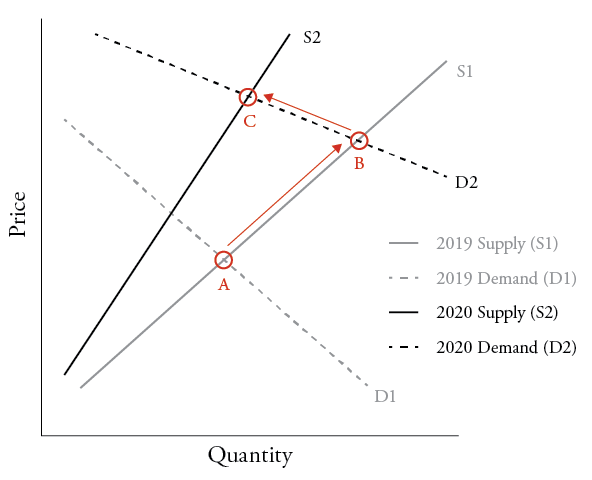
Figure 1 Current Market Equilibrium
In 2019, the market equilibrium in the Austin Area housing market was A. In 2020, there was a huge increase in demand due to the factors given above. It caused 2 situations. First, the market was not ready to embrace the rapid increase in demand. Also, housing is an essential good, which means new movers need to buy houses regardless of their price. Therefore, the elasticity of demand increased, and the demand curve moved to the right so much. The market equilibrium was changed to B. The other situation happened on the supply side. There had not been enough quantity when the demand curve changed to D2. Many developers hurried to provide more quantity in the market, but because of the construction period, the supply-side was not able to react instantly. Therefore, although the elasticity of supply increased, houses in the market ran out quickly. It made the supply curve move from S1 to S2, and the market equilibrium was changed to C.
Market Forecast
Future Demand and Supply.
For the last few months, the houses in the market have tended to increase gradually. Also, new housing projects that started early 2020 are almost done and it would help to ease the shortage in the market. However, it is expected that in the extremely short run, the supply would be not enough. It needs more time to resolve the current market imbalances.
In the case of the demand side, there is not any clue that the demand will slow down soon. Therefore, in the short term, the current tendency of demand will maintain. However, in the long term, the level of demand will settle down and find the market equilibrium.
Short-term
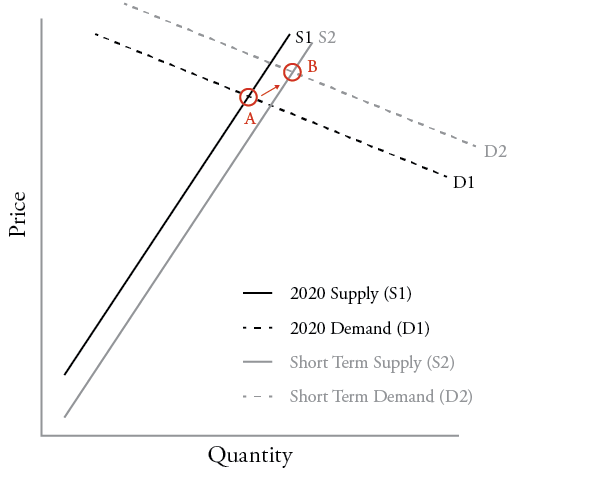
Figure 2 Short-term Forecast
Demand will increase, and supply will slowly start to increase. However, the expected supply is not enough to offset large demand. Therefore, the price will be similar or a little bit higher than the current one.
Short-term Equilibrium
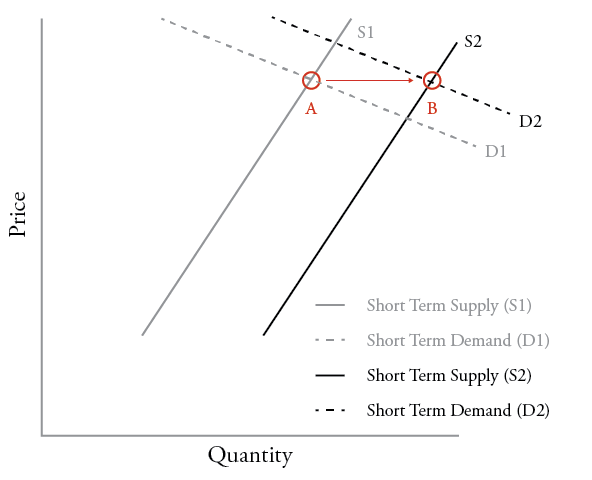
Figure 3 Short-term Market Equilibrium
Supply level will increase more than demand level, and finally, supply reaches the demand. Point B represents short-term equilibrium. There will be a slight increase in price, and once supply and demand find an equilibrium, the price will maintain.
Intermediate Term
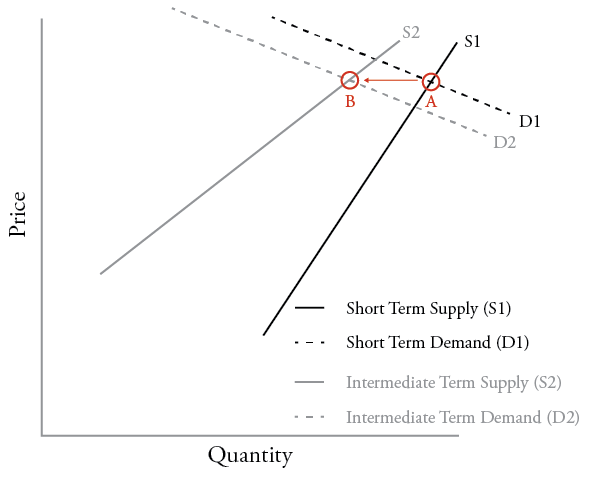
Figure 4 Intermediate Term Forecast
The supply level starts to decrease and supply elasticity also decreases because there are enough dwelling units in the market. Demand level starts to decrease as well, but the decrease of supply is larger than the decrease of demand. Price will maintain at the same level or increase slightly.
Long-term Equilibrium
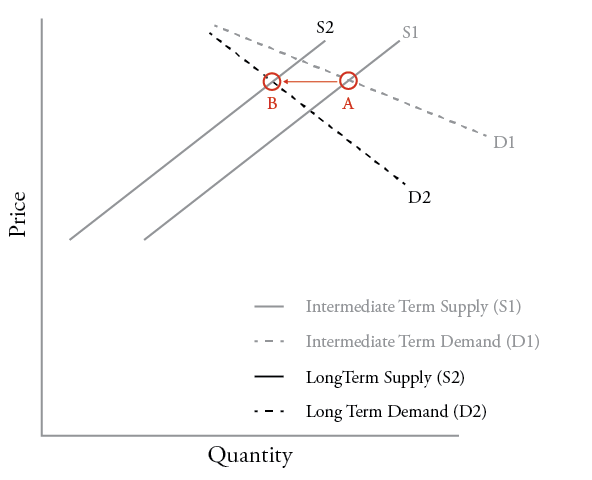
Figure 5 Long-term Market Equilibrium
Supply and Demand decrease together until they find the long-term market equilibrium. The elasticity of demand also decreases. Price will maintain at the same level or increase slightly. Compared to the market equilibrium in 2019, the price will be much higher, and the number of transactions will be also higher under the long-term equilibrium.
Summary and Conclusion
The US housing market has been experiencing a rapid price increase and short supply. It seems because of the pandemic, low-interest rate, and higher personal saving rate. The housing market in the Greater Austin Area was not an exception. In addition to these national factors, regional factors including an influx of more jobs with higher salaries, and an increase in population, have made the situation much worse in the housing market in the Austin Area. Despite skyrocketing demand, there has not been enough supply in the market for the last year, and it caused a rapid price increase. Recently, the market showed signs of an increase in supply. Even though the expected supply in 2021 is not enough to ease the market, it would help to slow down the rapid price rise. The price will increase until there will be enough supply in the market. Once, supply level meets the demand level, the market will try to find long-term equilibrium. It is expected that the long-term equilibrium price will be higher than the current price and the transaction volume will be similar or a little bit higher than the current one.
Bibliography
Zillow. “United States Home Values.” Zillow: Real Estate, Apartments, Mortgages & Home Values. Zillow, accessed June 21, 2021. https://www.zillow.com/home-values.
Zillow. “Austin-Round Rock Metro Home Values.” Zillow: Real Estate, Apartments, Mortgages & Home Values. Zillow, accessed June 21, 2021. https://www.zillow.com/austin-round-rock-metro-tx_r394355/home-values.
Froeb, Luke M., McCann, Brian T., Shor, Mikhael, and Ward, Michael R. Managerial Economics, Fifth Edition. Boston, MA: Cengage Learning, 2017.
US Census Bureau. “Evaluation Estimates.” The United States Census Bureau. US Census Bureau, accessed June 21, 2021. https://www.census.gov/programs-surveys/popest/technical-documentation/research/evaluation-estimates.html.
US Census Bureau. “Austin – Place Explorer – Data Commons.” Data Commons Place Explorer. Data Commons, accessed June 21, 2021. https://datacommons.org/place/geoId/4805000.
Stolba, Stefan Lembo. “Average Age to Buy a House.” Experian. Experian, December, 15, 2020. https://www.experian.com/blogs/ask-experian/research/average-age-to-buy-a-house.
Statista Research Department. “U.S. population by generation 2019.” Statista – The Statistics Portal. Statista, January 20, 2021. https://www.statista.com/statistics/797321/us-population-by-generation.
Zillow Research. “Experts: Work From Home is Here to Stay, and More Inventory is on the Way.” Zillow: Real Estate, Apartments, Mortgages & Home Values. Zillow, April 14, 2021. https://www.zillow.com/research/zhpe-q1-2021-work-from-home-29311.
Marshall, Joey, Burd, Charlynn, and Burrows, Michael. “Those Who Switched to Telework Have Higher Income, Education and Better Health.” The United States Census Bureau. US Census Bureau, March 31, 2021. https://www.census.gov/library/stories/2021/03/working-from-home-during-the-pandemic.html.
Rodenbeck, Ryan. “Austin Economic Forecast 2021.” Spyglass Realty – The Best Real Estate Agents in Austin, TX. Spyglass Realty, March 1, 2021. https://www.spyglassrealty.com/blog/austin-economic-forecast-2020.html.
Hardison, Kathryn. “What a $17B Samsung investment might look like.” Austin Business News – Austin Business Journal. Austin Business Journal, February 12, 2021. https://www.bizjournals.com/austin/news/2021/02/11/breaking-down-samsung-17b-investment.html.
Gottsegen, Gordon. “Oracle Announces Austin as Corporate HQ, Moving From Bay Area.” Austin Tech & Startups | Built In Austin. Built In Austin, December 14, 2020. https://www.builtinaustin.com/2020/12/14/oracle-moves-hq-austin-hiring.
FRED Economic Data. “ Effective Federal Funds Rate (FEDFUNDS).” Federal Reserve Economic Data | FRED | St. Louis Fed. Federal Reserve Bank of St. Louis, accessed June 20, 2021. https://fred.stlouisfed.org/series/FEDFUNDS.
Statista Research Department. “Personal saving rate in the United States from June 2015 to February 2021.” Statista – The Statistics Portal. Statista, March 31, 2021. https://www.statista.com/statistics/246268/personal-savings-rate-in-the-united-states-by-month.
Texas Real Estate Research Center. “Housing Activity for Austin-Round Rock.” Real Estate Center. Texas Real Estate Research Center at Texas A&M University, accessed June 16, 2021. https://www.recenter.tamu.edu/data/housing-activity/#!/activity/MSA/Austin-Round_Rock.
Austin Board of Realtors. “Central Texas Housing Market Report May 2021.” Austin Board of REALTORS®. Austin Board of REALTORS®, accessed June 20, 2021. https://www.abor.com/content/uploads/2021/06/2021-05-Central-Texas-Housing-Market-Report.pdf.
Mueller Laura. “How Long Does It Take to Build a New Construction House?.” Movers – Local & Long Distance Moving Services. Move, Inc., June 8, 2020. https://www.moving.com/tips/how-long-does-it-take-to-build-a-new-construction-house.
Texas Real Estate Research Center. “Building Permit Data for Austin-Round Rock, TX.” Real Estate Center. Texas Real Estate Research Center at Texas A&M University, accessed June 16, 2021. https://www.recenter.tamu.edu/data/building-permits/#!/msa/Austin-Round_Rock%2C_TX.
Zillow Research. “Experts: Work From Home is Here to Stay, and More Inventory is on the Way.” Zillow: Real Estate. Apartments, Mortgages & Home Values, Zillow, April 14, 2021. https://www.zillow.com/research/zhpe-q1-2021-work-from-home-29311.
Rydell, C. Peter. Price Elasticities of Housing Supply. Santa Monica, CA: RAND Corporation, 1992. https://www.rand.org/pubs/reports/R2846.html. Also available in print form.
Bank Underground. “The declining elasticity of US housing supply.” Bank Underground. Bank Underground, February 25, 2020. https://bankunderground.co.uk/2020/02/25/the-declining-elasticity-of-us-housing-supply.
Hanushek, Eric A., and John M. Quigley. “What Is the Price Elasticity of Housing Demand?” The Review of Economics and Statistics 62, no. 3 (1980): 449-54. Accessed June 22, 2021. doi:10.2307/1927113.
- Zillow, “United States Home Values,” Zillow: Real Estate, Apartments, Mortgages & Home Values, Zillow, accessed June 21, 2021, https://www.zillow.com/home-values.
- Zillow, “Austin-Round Rock Metro Home Values,” Zillow: Real Estate, Apartments, Mortgages & Home Values, Zillow, accessed June 21, 2021, https://www.zillow.com/austin-round-rock-metro- tx_r394355/home-values.
- Luke M. Froeb et al., Managerial Economics, Fifth Edition (Boston, MA: Cengage Learning, 2017). 95-96.
- Luke M. Froeb et al., Managerial Economics, Fifth Edition.
- US Census Bureau, “Evaluation Estimates,” The United States Census Bureau, US Census Bureau, accessed June 21, 2021, https://www.census.gov/programs-surveys/popest/technical-documentation/research/evaluation-estimates.html.
- Data Commons, “Austin – Place Explorer – Data Commons,” Data Commons Place Explorer, Data Commons, accessed June 21, 2021, https://datacommons.org/place/geoId/4805000.
- Stefan Lembo Stolba, “Average Age to Buy a House,” Experian. Experian, December, 15, 2020. https://www.experian.com/blogs/ask-experian/research/average-age-to-buy-a-house.
- Statista Research Department, “U.S. population by generation 2019,” Statista – The Statistics Portal, Statista, January 20, 2021, https://www.statista.com/statistics/797321/us-population-by-generation.
- Zillow Research, “Experts: Work From Home is Here to Stay, and More Inventory is on the Way,” Zillow: Real Estate, Apartments, Mortgages & Home Values, Zillow, April 14, 2021, https://www.zillow.com/research/zhpe-q1-2021-work-from-home-29311.
- Joey Marshall, Charlynn Burd, and Michael Burrows, “Those Who Switched to Telework Have Higher Income, Education and Better Health,” The United States Census Bureau, US Census Bureau, March 31, 2021, https://www.census.gov/library/stories/2021/03/working-from-home-during-the-pandemic.html.
- Ryan Rodenbeck, “Austin Economic Forecast 2021,” Spyglass Realty – The Best Real Estate Agents in Austin, TX, Spyglass Realty, March 1, 2021, https://www.spyglassrealty.com/blog/austin-economic-forecast-2020.html.
- Kathryn Hardison, “What a $17B Samsung investment might look like,” Austin Business News – Austin Business Journal, Austin Business Journal, February 12, 2021, https://www.bizjournals.com/austin/news/2021/02/11/breaking-down-samsung-17b-investment.html.
- Gordon Gottsegen, “Oracle Announces Austin as Corporate HQ, Moving From Bay Area,” Austin Tech & Startups | Built In Austin, Built In Austin, December 14, 2020, https://www.builtinaustin.com/2020/12/14/oracle-moves-hq-austin-hiring.
- FRED Economic Data, “Effective Federal Funds Rate (FEDFUNDS),” Federal Reserve Economic Data | FRED | St. Louis Fed, Federal Reserve Bank of St. Louis, accessed June 20, 2021, https://fred.stlouisfed.org/series/FEDFUNDS.
- Statista Research Department, “Personal saving rate in the United States from June 2015 to February 2021,” Statista – The Statistics Portal, Statista, March 31, 2021, https://www.statista.com/statistics/246268/personal-savings-rate-in-the-united-states-by-month.
- Texas Real Estate Research Center, “Housing Activity for Austin-Round Rock,” Real Estate Center, Texas Real Estate Research Center at Texas A&M University, accessed June 16, 2021, https://www.recenter.tamu.edu/data/housing-activity/#!/activity/MSA/Austin-Round_Rock.
- Austin Board of Realtors, “Central Texas housing Market Report May 2021,” Austin Board of REALTORS®, Austin Board of REALTORS®, accessed June 20, 2021, https://www.abor.com/content/uploads/2021/06/2021-05-Central-Texas-Housing-Market-Report.pdf.
- Laura Mueller, “How Long Does It Take to Build a New Construction House?” Movers – Local & Long Distance Moving Services, Move, Inc., June 8, 2020, https://www.moving.com/tips/how-long-does-it-take-to-build-a-new-construction-house.
- Texas Real Estate Research Center, “Building Permit Data for Austin-Round Rock, TX,” Real Estate Center, Texas Real Estate Research Center at Texas A&M University, accessed June 16, 2021, https://www.recenter.tamu.edu/data/building-permits/#!/msa/Austin-Round_Rock%2C_TX.
- Zillow Research, “Experts: Work From Home is Here to Stay, and More Inventory is on the Way,” Zillow: Real Estate, Apartments, Mortgages & Home Values, Zillow, April 14, 2021, https://www.zillow.com/research/zhpe-q1-2021-work-from-home-29311.
- C. Peter Rydell, Price Elasticities of Housing Supply (Santa Monica, CA: RAND Corporation, 1992), https://www.rand.org/pubs/reports/R2846.html. Also available in print form.
- Bank Underground, “The declining elasticity of US housing supply,” Bank Underground, Bank Underground, February 25, 2020, https://bankunderground.co.uk/2020/02/25/the-declining-elasticity-of-us-housing-supply.
- Texas Real Estate Research Center, “Housing Activity for Austin-Round Rock.”
- Texas Real Estate Research Center, “Housing Activity for Austin-Round Rock.”
- Eric A. Hanushek, and Quigley John M., “What Is the Price Elasticity of Housing Demand?” The Review of Economics and Statistics 62, no. 3 (1980): 449-54, Accessed June 22, 2021, doi:10.2307/1927113.